AI agents do not spend all their time writing. Before an agent calls a tool, routes a request, approves a step, or asks a person to intervene, it has to make a decision.
That decision layer is easy to overlook because modern AI products are usually described in terms of language: prompts, context windows, reasoning, and generated answers. Yet an agent succeeds or fails just as often on smaller questions: Which team owns this request? Is the action allowed? Which tool is relevant? Does this case require review?
These are questions of decision intelligence: using available evidence to choose the next action. Jev is interesting because it is designed around that job rather than around generating language.
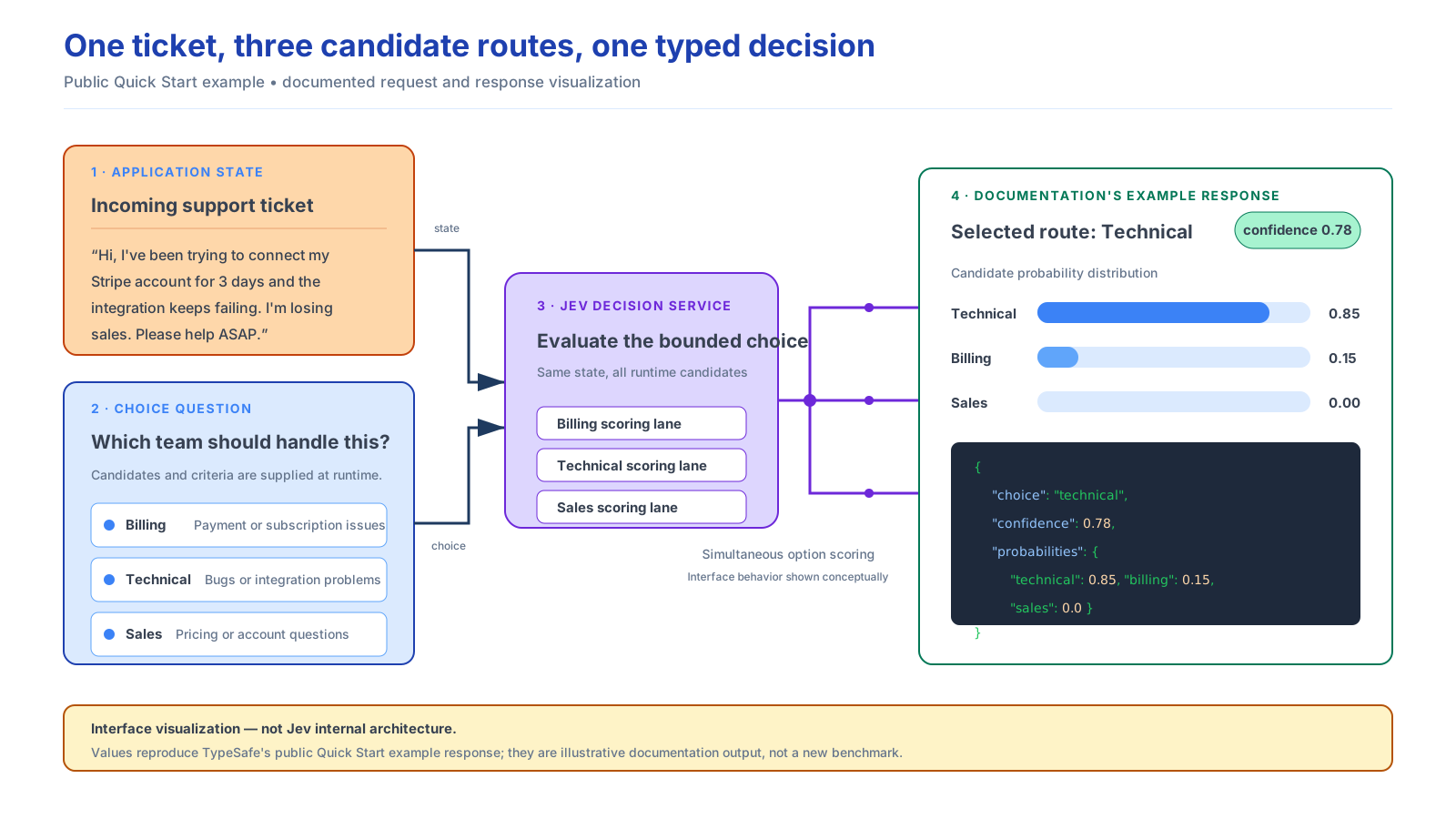
The example makes Jev’s proposition concrete. The application supplies a real support message, a bounded question, and three candidate teams with plain-language criteria. Jev returns every candidate’s probability, the selected route, and a confidence value in a typed response. The diagram preserves TypeSafe’s published example values so readers can follow the interface end to end.
The decisions hidden inside an agent workflow
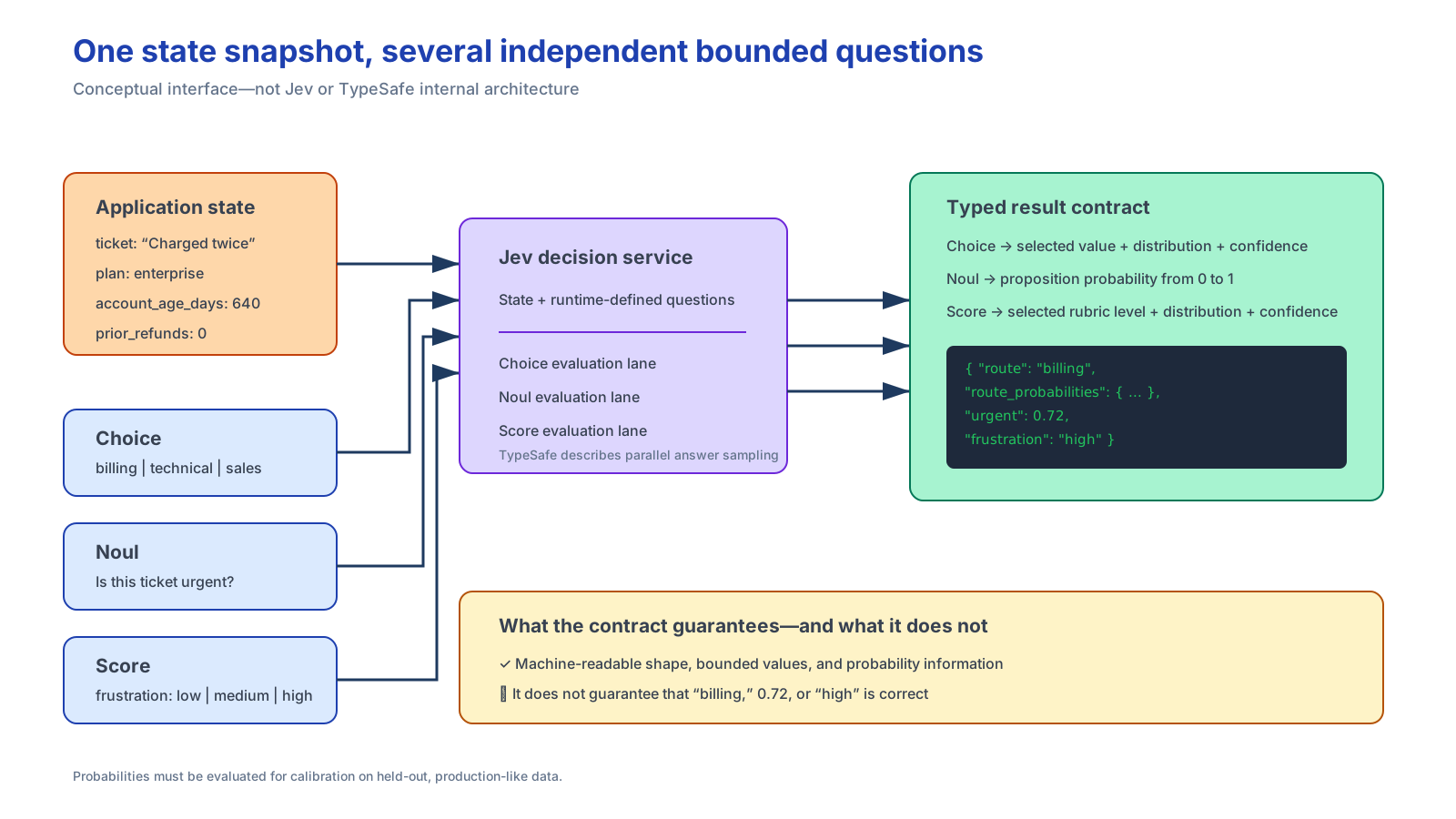
Consider a customer-support ticket: “My card was charged twice and I cannot cancel.” A useful agent may need to route it to the right team, decide whether it is urgent, score the customer’s frustration, determine whether a person must review it, and finally write a response.
The first four outputs have known boundaries. A route is selected from a list, urgency can be represented as a proposition, and frustration can be scored against a rubric. The final task is different: a good reply may take many valid forms.
That is the useful separation:
- A bounded decision selects a value from a defined space.
- Generation creates an open-ended sequence of language.
An LLM can do both, but it always approaches the task through its generative machinery. For a decision that contains only a few bits of useful information, generation may be more machinery than the application needs. Jev’s proposal is to make bounded decisions a first-class model interface.
What is Jev?
TypeSafe AI introduced Jev in early access on September 15, 2026. The company calls it the first public System One Model: a model for fast, structured decisions that software can consume directly.
In plain terms, Jev receives the current application state and a set of typed questions. It returns bounded values and probability information rather than free-form prose. A support system can ask for a department, an urgency judgment, and a severity score without asking the model to compose and serialize a paragraph.
“System One Model” is TypeSafe’s product category, not an established architecture family such as an encoder-only transformer. The name refers to Daniel Kahneman’s description of fast, intuitive “System 1” thinking. “Jev” refers to economist William Stanley Jevons and the idea that reducing the cost of a decision can make many more decisions economically practical.
Jev was built by TypeSafe AI, whose founders are Diogo Almeida, Sasha Sheng, and Erik Gafni. The team describes Almeida as a co-inventor of RLHF and InstructGPT; he is an author of the InstructGPT paper. This background helps explain the company’s interest in changing how models are trained for useful behavior, but it is not evidence that Jev will perform well on every workload.
State plus typed questions
The public Jev interface has two main inputs:
- State is the evidence available for the decision: a message, account facts, transaction history, tool results, or structured metadata.
- Questions define exactly what the application wants to decide.
TypeSafe documents three question forms:
- Choice selects among named candidates and returns their probabilities plus a selected value and confidence.
- Noul evaluates a proposition and returns a value between
0and1. The confidence documentation notes that Noul does not have a separate confidence field; its value is the probability of the proposition itself. - Score evaluates ordered levels defined by a rubric and returns probability information, a selected score, and confidence.
A routing request from the TypeSafe Quick Start uses this state and Choice definition:
{
  "state": "Hi, I've been trying to connect my Stripe account for 3 days and the integration keeps failing. I'm losing sales. Please help ASAP.",
  "model": "jev-latest",
  "questions": {
    "department": {
      "type": "choice",
      "instructions": "Which team should handle this?",
      "criteria": {
        "billing": "Payment or subscription issues",
        "technical": "Bugs or integration problems",
        "sales": "Pricing or account questions"
      }
    }
  }
}
In the documentation’s example response, Jev selects technical, reports confidence 0.78, and returns candidate probabilities of 0.85 for technical, 0.15 for billing, and 0.0 for sales. These numbers illustrate the API response; they are not a benchmark result. Application code can consume them directly without extracting an answer from prose.
This is type safety, not a guarantee of truth. Returning only an allowed department prevents an invalid output shape; it does not prevent the model from choosing the wrong department. Schema correctness and semantic correctness remain separate.
TypeSafe also recommends asking one thing per question. Instead of asking whether an entire startup is “good,” an application can separately evaluate market size, execution feasibility, and differentiation. The model supplies assessments; code remains responsible for combining them according to business policy.
What TypeSafe says happens—and what remains unknown
TypeSafe makes three notable public claims about Jev:
- it uses a new model architecture;
- a parallel sampler evaluates multiple questions over the same state without generating one long autoregressive sequence; and
- it is trained with Reinforcement Learning for Calibrated Decisions (RLCD) to improve decision probabilities.
These are company descriptions. TypeSafe has not publicly disclosed Jev’s parameter count, architecture family, training corpus, full training recipe, or the complete mechanics of RLCD. It is therefore not responsible to describe Jev as BERT, a small decoder LLM, or any other familiar architecture.
Sebastian Raschka’s independent analysis, Language Models for Text Classification: From Bag-of-Words to Jev, offers a useful Jev-like implementation intuition: a shared model could score natural-language candidate descriptions, then normalize the scores into a distribution. That explains how a runtime-defined choice interface might be built. It does not reveal Jev’s internals or reproduce the broad generalization, latency, or calibration that TypeSafe claims.
Why generation-free decisions may change latency and cost
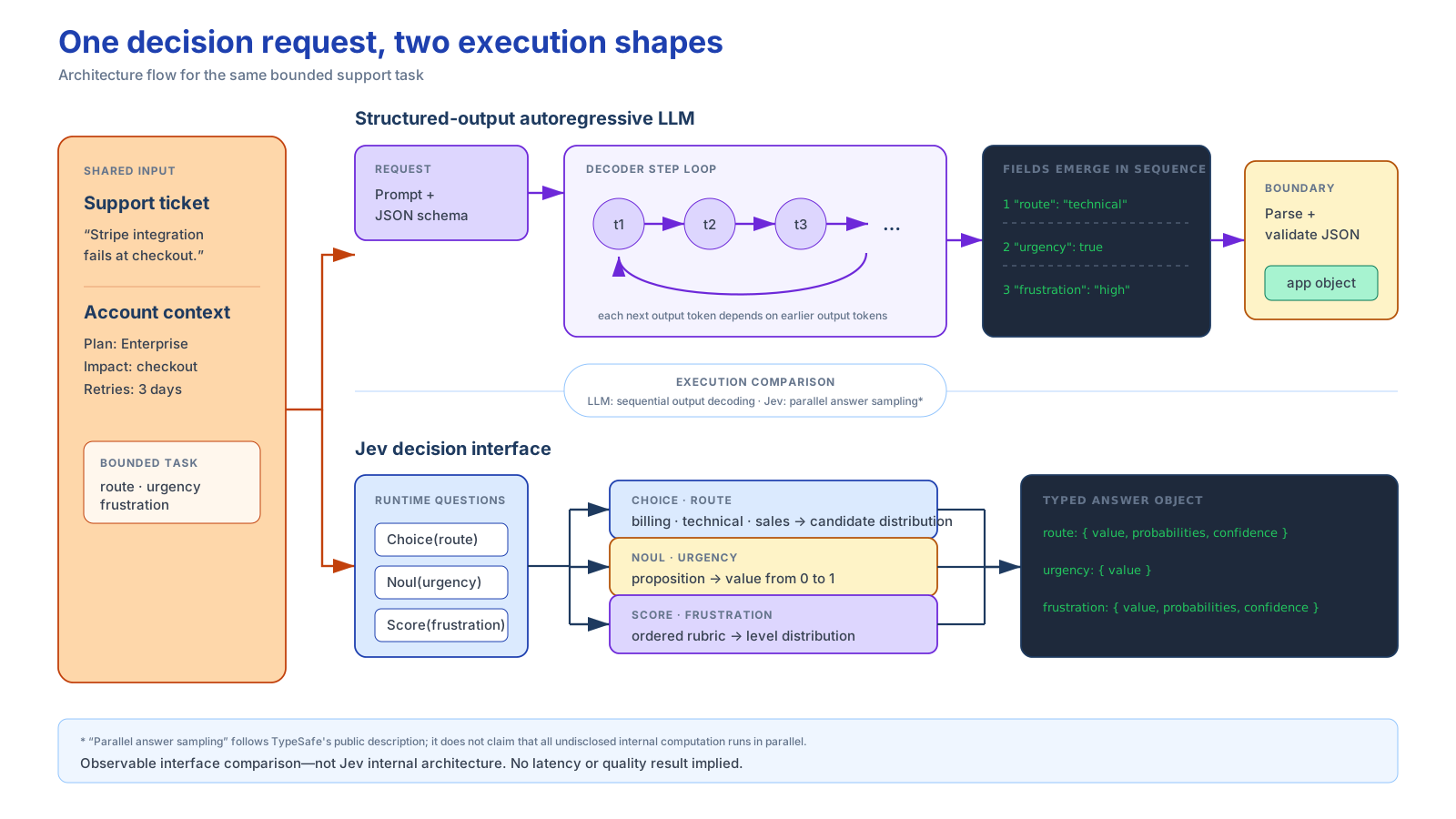
Autoregressive LLMs produce output token by token. Structured-output systems can constrain those tokens into valid JSON, but decoding still happens sequentially. If the application needs only billing, 0.92, and high, generating and validating a token sequence adds work around a very small decision.
Jev’s public design aims to avoid that output-generation loop for bounded tasks. In its launch description, TypeSafe says Jev’s sampler produces answers to multiple questions in parallel. The architecture flow below compares the observable execution shape of the two interfaces: sequential output decoding for a structured-output LLM, versus a fan-out of typed questions and fan-in of typed answers for Jev. It is not a complete system diagram, and the vendor’s sampling claim is not evidence that every undisclosed internal operation runs in parallel. If the service behaves as described, the interface can reduce output generation and parsing work around several small decisions from the same state.
TypeSafe publishes latency, pricing, and workflow-comparison figures on its site and evaluation pages. Those are vendor-reported service measurements, not universal model properties. Network region, payload size, concurrency, decision quality, escalation rate, and the cost of mistakes all affect the real economics. The useful production metric is not merely price per token; it is cost per accepted correct decision.
Where Jev could fit in an agent
Jev is most relevant where the application repeatedly asks bounded questions whose definitions may change faster than a specialist model can be retrained.
Support and operations
Given a ticket plus account state, an application can ask for a route, urgency probability, issue type, or review requirement. The customer-facing reply can remain an LLM task; Jev handles the decisions around it.
Tool and skill selection
An agent can evaluate which available tool or skill best matches a request. Code should still enforce permissions and validate arguments. The decision model recommends; the application authorizes.
Safety and prompt-injection screening
Separate Noul or Choice questions can flag suspicious instructions, data-exfiltration intent, or a mismatch between a request and the user’s permissions. This is a signal for a broader security policy, not a complete security boundary.
Reasoning-effort and model routing
A system can estimate whether a request is simple, ambiguous, or reasoning-heavy before selecting an inference budget or downstream model. This may reserve expensive generation for cases that need it.
Review, relevance, and evidence triage
Document relevance, candidate-file selection, test-failure categorization, and review priority are naturally bounded. Jev can provide a reusable interface when the candidate set or rubric changes at runtime.
In all of these examples, the clean boundary is the same: the model evaluates evidence; code owns policy and permission. For consequential actions, low confidence or high risk should lead to a stronger model or human review, but that escalation mechanism need not dominate the architecture.
Probability is not the same as accuracy
A response of 0.90 does not mean the model is universally 90% accurate. Calibration is a measured relationship across a population of predictions: among cases assigned about 0.90 probability, about 90% should be correct if the model is well calibrated on that population.
TypeSafe says RLCD is intended to produce calibrated decisions. Because the method and training evidence are not fully public, teams should test that claim on their own traffic. Domain shift, new labels, policy changes, languages, and adversarial inputs can all change calibration.
Useful checks include reliability diagrams, Brier score, expected calibration error, accuracy by probability band, and direct review of high-confidence mistakes. A single global score is not enough. Calibration should be examined by task, class, and consequential subgroup.
Confidence needs equally careful interpretation. For Choice and Score, a concentrated distribution can support a high confidence value. That tells the application the model’s candidate probabilities are sharply separated; it does not prove that the leading candidate is correct. For Noul, the returned value itself represents the proposition probability rather than a separate confidence field.
Jev compared with the alternatives
Jev does not make classification a new AI capability. Classical classifiers, BERT-style encoders, and fine-tuned LLM classifiers already make bounded predictions—and a well-trained specialist may be the best system for a stable task.
Jev’s value proposition instead targets two recurring deployment trade-offs. Specialist classifiers commonly bind a trained model or head to one fixed task, so a changed label set or rubric can require new data, fine-tuning, validation, and deployment. General-purpose LLMs can accept a new task at runtime, but a structured-output LLM still expresses the decision by generating and validating a sequential string. Jev offers a third interface: define typed questions at runtime and receive bounded values and probabilities without free-form output generation.
That proposition comes with real limitations. Jev is a closed, hosted early-access service; its architecture, size, training data, and complete RLCD method remain undisclosed. Its calibration and decision quality must be tested on each domain. For a stable, high-volume task with representative labels, logistic regression or a fine-tuned encoder may be cheaper, more controllable, locally deployable, and more accurate.
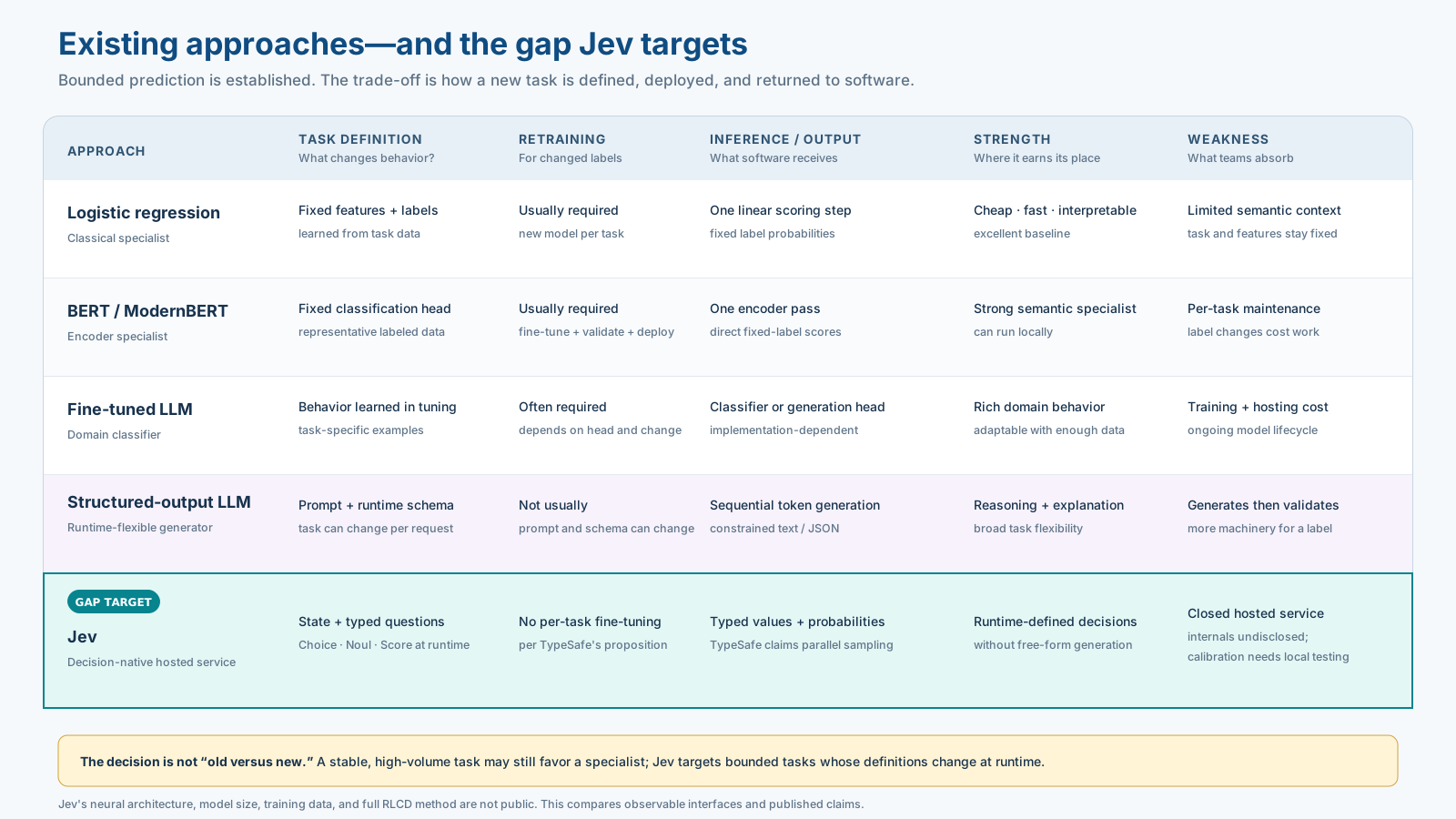
| Approach | How the task is defined | Inference and output | Best fit |
|---|---|---|---|
| Logistic regression | Fixed features and labels learned from task data | One cheap linear scoring step | Stable, lexically simple, high-volume baseline |
| BERT / ModernBERT classifier | Fine-tuned encoder and task-specific classification head | Direct label scores in one encoder pass | Stable semantic task with representative labeled data |
| Fine-tuned LLM classifier | Task behavior learned by fine-tuning a pretrained model | Depends on the chosen classification or generative head | Domain-specific task where fine-tuning cost is justified |
| Structured-output autoregressive LLM | Runtime prompt and schema | Sequentially generated text or JSON | Decisions requiring reasoning, explanation, or rapid task flexibility |
| Jev | Runtime state plus Choice, Noul, or Score questions | TypeSafe claims parallel typed decisions and probabilities | Changing bounded tasks without per-task fine-tuning |
Logistic regression deserves a place in every benchmark: it is inexpensive, interpretable, and sometimes sufficient. BERT or ModernBERT can be a stronger semantic specialist and can run locally. A fine-tuned LLM classifier can encode richer domain behavior but introduces training, hosting, and maintenance costs. A structured-output LLM remains the strongest choice when the decision depends on open-ended reasoning or must be accompanied by generated language.
Jev’s distinctive proposition is not that classification is new. It is that one reusable service can accept task definitions at runtime while retaining a decision-native, probabilistic contract. Whether that advantage outweighs a mature specialist must be measured.
When not to use Jev
Jev is a poor fit when the required output is an explanation, plan, summary, or creative response. It is also unnecessary when deterministic rules already express the policy exactly.
A task-specific classifier may be better when the label set is stable, high-quality training data exists, volume is large, local deployment matters, or privacy rules prevent sending state to a hosted service. A general LLM may be better when a decision depends on multi-step reasoning, tool results that must be synthesized, or language that must be generated anyway.
Do not let any probabilistic model directly authorize irreversible financial, legal, safety, account, or communication actions without code-owned constraints and appropriate human accountability.
A production evaluation checklist
Before placing Jev in a live path:
- Define each decision, allowed output, error cost, and owner.
- Build a representative labeled evaluation set, including difficult and shifted cases.
- Compare current rules, logistic regression, a specialist encoder, a structured-output LLM, and Jev where appropriate.
- Measure per-class quality, calibration, high-confidence errors, p95 latency, throughput, failure rate, and cost per accepted correct decision.
- Run in shadow mode before allowing decisions to change state.
- Set thresholds by action risk and reversibility, not by one global confidence number.
- Monitor drift and retain an audit trail linking state, question version, answer, and outcome.
The decision layer is the real idea
Jev matters because it makes a neglected part of agent design explicit. Agents need generation, but they also need a disciplined way to make many small, bounded, probabilistic decisions that software can inspect and govern.
TypeSafe’s early-access model is still a closed system with important unanswered questions. Its latency, calibration, domain robustness, privacy fit, and cost should be verified rather than assumed. But the architectural idea is useful today: separate decisions from generation, ask one bounded question at a time, keep policy in code, and evaluate probabilities as carefully as labels.
Jev may prove to be a strong implementation of that idea. Even where another classifier wins, decision intelligence deserves its own layer in the agent architecture.
Sources and claim boundaries
- TypeSafe AI: Introducing System One Models & Jev — primary source for the launch, product framing, architecture claim, parallel sampler, and RLCD.
- TypeSafe documentation — primary source for state, question types, request structure, and interface guidance.
- Sebastian Raschka: Language Models for Text Classification: From Bag-of-Words to Jev — independent classifier history, comparison, calibration discussion, and Jev-like implementation analysis.
- ModernBERT paper — primary technical reference for the contemporary encoder mentioned in the comparison.
- scikit-learn calibration guide — practical reference for reliability diagrams and classifier calibration.
Descriptions of Jev’s internals are limited to TypeSafe’s public statements. Raschka’s candidate-scoring construction is presented as an independent Jev-like design, not as reverse engineering of the proprietary model.